
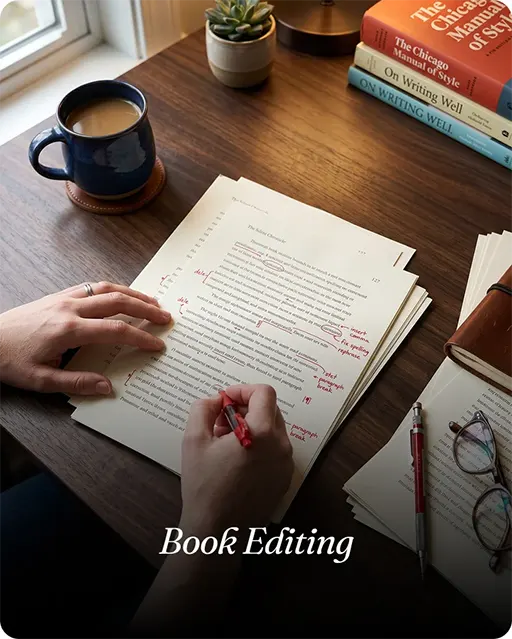
Professional editing
The edit that turns a draft into a book
Developmental, structural, line and copy editing for Australian authors, with an honest assessment first, so you only pay for the level of editing your manuscript actually needs.
What editing actually is
Not proofreading. Not rewriting. Something else entirely
Most first-time authors think editing means fixing typos. That is proofreading, and it is the last thing that happens, not the first.
Editing is a series of increasingly fine passes. The first asks whether the book works at all: whether the structure holds, whether the argument lands, whether a reader will stay to the end. Later passes work at paragraph level, then sentence level, then word level. Each assumes the one before it is settled.
A good editor does not impose their voice on yours. They find the places where your intention and the words on the page have come apart, and they show you the gap.
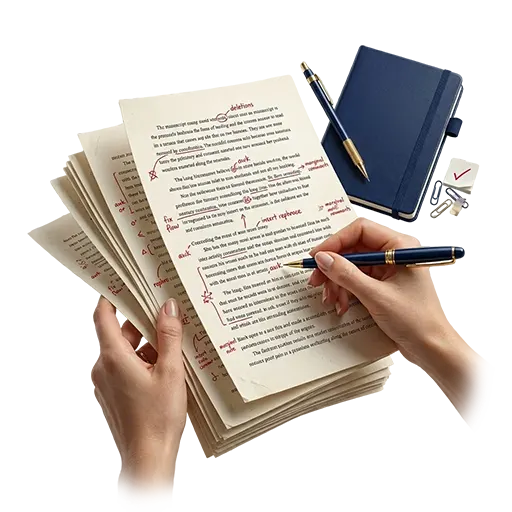
The levels
Four kinds of editing, working from the outside in
These are sequential, not alternatives. A manuscript that needs developmental work will also need the levels below it afterwards.
Developmental editing
The big structural questions. Does the book deliver what its premise promises? Is the arc complete? In fiction: does the plot hold, do the characters change, is the pacing right? In non-fiction: is the argument sound, is the evidence there, is the chapter order the most persuasive one? Delivered as a detailed report rather than in-line changes, because the fixes are yours to make.
Structural editing
Closer than developmental, working at chapter and scene level. Reordering, tightening, identifying what should be cut and what needs expanding. Often the point at which a manuscript loses ten thousand words and reads twice as well.
Line editing
Sentence by sentence, for rhythm, clarity and voice. Removing the padding, fixing sentences that technically parse but do not land, and cutting the tics every writer has and cannot see. This is where prose gets its polish.
Copy editing
Grammar, punctuation, spelling, consistency and factual sense-checking. Ensuring your character's eyes stay the same colour and your timeline does not contradict itself. Produces the style sheet that governs the rest of the project.
A common confusion
Editing versus proofreading
They are different jobs, done at different times, by people looking for different things.
| Editing | Proofreading | |
|---|---|---|
| When it happens | Before design and typesetting | After typesetting, on the laid-out pages |
| What it works on | Structure, argument, voice, sentences | Errors that survived everything before |
| Scale of change | Can be substantial: chapters moved or cut | Minimal: a correction, not a rewrite |
| Typical output | Tracked changes, editorial report, style sheet | A marked list of corrections to apply |
| Can it replace the other? | No: editing does not catch layout errors | No: proofreading will not fix a broken plot |
On the page
What an editor is actually reading for
The recurring problems are remarkably consistent across manuscripts, and all of them are fixable.
In fiction
- Openings that start three chapters before the story does
- Backstory delivered in blocks rather than in motion
- Dialogue that explains things the characters already know
- A protagonist things happen to, rather than one who acts
- Point-of-view slipping mid-scene
- Sagging middles and endings that arrive too fast
In non-fiction
- A chapter order that follows how you learned it, not how a reader needs it
- Claims stated more strongly than the evidence supports
- Jargon that assumes the reader shares your background
- Anecdotes doing the work that data should do, or the reverse
- Repetition across chapters written months apart
- Missing signposting, so readers lose the thread of the argument
How it works
The editorial process, start to finish
Collaborative throughout. You see every change and you decide what stays.
Sample read and assessment
You send a representative sample, usually the opening chapters plus one from the middle. An editor reads it and reports on what the manuscript needs, at what level, and roughly what that will cost.
Quote and scheduling
An itemised quote based on your actual word count and the level of editing recommended, with a schedule that includes time for your own review between passes.
The editing pass
Your editor works through the full manuscript in tracked changes, with margin comments explaining anything substantive rather than silently altering it.
Editorial report
For developmental and structural work, a written report covering the manuscript as a whole: what is working, what is not, and specific recommendations.
Your review
You go through the tracked changes and accept, reject or query. Nothing is imposed. Queries come back to your editor rather than to a general inbox.
Second pass and handover
Once you have responded, your editor reviews the revised text and delivers the final file with the style sheet, ready for typesetting.

Deliverables
What lands in your inbox at the end
- The edited manuscript in tracked changes, so nothing is hidden from you
- A clean copy with all changes accepted, ready to move forward
- An editorial style sheet recording every decision on spelling, hyphenation, capitalisation, numbers and character or term naming
- An editorial report for developmental and structural work
- A query log listing anything the editor needed you to confirm
The style sheet matters more than authors expect. It travels with the book into typesetting and proofreading, and it is why a professionally produced book stays internally consistent across three hundred pages.
What we edit
Manuscripts we work on regularly
Full-length novels and novellas across most genres.
Where structure and selection matter more than chronology.
Books built on professional knowledge and case material.
Age-appropriate voice, reading level and length.
Questions
Editing questions, answered plainly
That is exactly what the assessment determines, and it is why we read a sample before quoting. Authors frequently ask for a copy edit when the manuscript needs structural work, and occasionally the reverse: a draft that is in better shape than the author feared. We will tell you which it is, including when the answer saves you money.
No. A competent editor works to make your voice clearer, not to replace it with theirs. Everything comes to you in tracked changes with comments explaining anything substantive, and you reject anything that does not sound like you. If an editor is rewriting rather than editing, that is a fault, not a service.
Yes, as the default, using the Macquarie Dictionary as our primary reference. If your book is aimed principally at a US readership, or your publisher requires a different standard, we will apply that instead, but it is a deliberate decision recorded on the style sheet, not an accident.
A copy edit on an 80,000-word manuscript typically takes two to three weeks. Line editing takes longer, and developmental work longer again because it involves a full read before any editing begins. Your schedule is confirmed with the quote.
Yes. Some authors commission an edit of the opening chapters to learn what the recurring problems are, then apply the lessons themselves across the rest. It is a genuinely economical approach for writers willing to do the work.
Reject it. It is your book. Where a change matters, your editor will have explained the reasoning in a comment, and you are welcome to discuss it, but the final call is always yours.
Beta readers tell you where a book lost them, which is genuinely valuable. They rarely tell you why, and almost never how to fix it. The two are complementary rather than interchangeable.
Continue
What usually comes next
Most authors combine two or three services. Tell us where your manuscript is and we will recommend only what it needs.
Next step
Send a sample and find out what your draft needs
An editor reads a representative portion of your manuscript and reports back on the level of editing required, including when that is less than you expected.
- Read by a person, not scored by software
- Honest recommendation on the level required
- Itemised quote with a realistic schedule
- No obligation to proceed
Prefer to talk it through? +61 2 8531 1369 · info@harbourbridgepress.com